
GREETINGS, BOOKWORMS! I’m Aisha Kandisha, Head Librarian at Kandisha Press. Join me in the dusty stacks of the library I will never leave again as I chat with some of my favorite Women in Horror. Today we feature author Geneve Flynn!
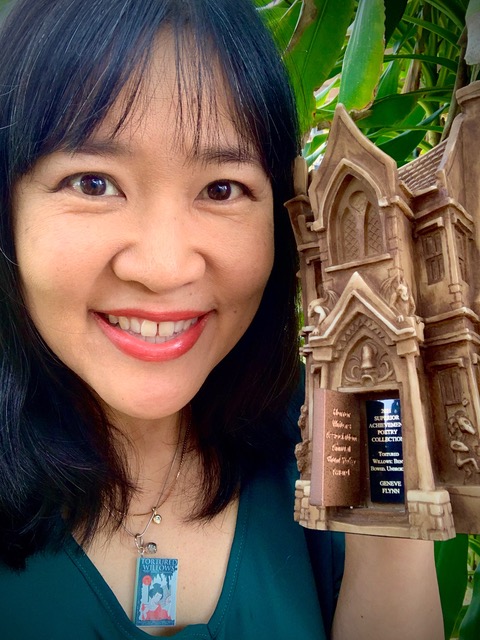
Geneve Flynn is a two-time Bram Stoker-, Shirley Jackson- and Aurealis Award-winning fiction editor, author, and poet. She has been nominated and shortlisted for the British Fantasy, Ditmar, Australian Shadows, Elgin, and Rhysling Awards, and the Pushcart Prize. She is a recipient of the 2022 Queensland Writers Fellowship. She is Chinese, born in Malaysia, and now calls Australia home. Her work has been published by Written Backwards, Crystal Lake Publishing, PS Publishing, Flame Tree Publishing, and PseudoPod.
Co-editor (with Lee Murray) of Black Cranes: Tales of Unquiet Women and poetry contributor to Tortured Willows: Bent, Bowed, Unbroken. She likes cups of tea and B-grade action movies.Read more at www.geneveflynn.com.au.
What made you want to become an author? Did you have an “Aha!” moment when you knew you were born to write? Or perhaps a beloved book inspired you?
I’m an incurable daydreamer who grew up to be an incurable writer. That tendency to live in a constant state of pre-occupation, never fully existing in the present but always lost in a thousand possible what-ifs, is inbuilt. And no matter what digressions I made along the way, I would always have found a path back to writing.
The “Aha!” moment when I realised not only could I write, but I could write to disturb was when my English teacher asked us to read our work to the class. After my turn, the whole room was silent and poor Mrs Errez said faintly: “Thank you. That was…good. Very dark but…good.” Bless her cotton socks. Wherever she is now, I hope she’s all right.
I was also an incorrigible reader. I read late into the night, on the bus, at the dinner table (sorry, Mum), anywhere and everywhere there was enough light to see the words. One book in particular made me fall in love with horror and I’ll never forget the experience. I wish I could go back in time, just so I could relive that moment. In high school, a friend handed me Stephen King’s It and told me I needed to read it. She was right. It was like a lightbulb blazed to life in my head. This was what I wanted to write, needed to write: stories that broke your heart, that were frightening, that pulled back the veil and showed you all of life—the lovely, the ugly, the good, and bad.

What do you believe are your strengths in writing? And when you feel you need to improve on a particular writing skill, how do you go about it?
My writing has been described as creepy, so that’s a strength, I guess. I also have a background in psychology, which helps a lot with characterisation, and I work as an editor, so all the story craft I’ve picked up along the way is incredibly helpful for writing my own fiction. Something which I never used to view as a positive has actually become a strength in my writing—my Asian heritage. For the longest time, I thought I had to hide the fact that I’m Chinese or Malaysian if I wanted to get published. But tapping into my diasporic experience, the culture, the family dynamics, the unique worldview, the spiritual side, and being honest and curious about all of it has helped me to find my voice.
When I want to improve on a particular skill, I’ll dive down rabbit holes to learn and seek out examples of how it’s done. I’ll read work that exemplifies the skill, and then I’ll play. That’s kind of how I wrote the poems for Tortured Willows: Bent, Bowed, Unbroken, which (much to my astonishment and delight) won a Bram Stoker Award. When Angela Yuriko Smith and Lee Murray invited me to collaborate (along with Christina Sng) on the collection, I’d never written poetry before. I went in search of poetry blogs, read poetry, and wrote and wrote and wrote. We had a very tight deadline so there was very little time to dither and have doubts.
I think that’s a pretty good way to go about improving anything—learn as you go, jump in without preconceptions of whether you’ll suck, and work as fast as you can to outpace that looming deadline. You never know how things will turn out.
What are your thoughts on the book industry today, or more importantly, about the book community? Do you feel it is getting harder or easier to make it as an independent author these days?
The book industry seems to be in a state of tectonic shift. With the advent of e-books, the growth of smaller, independent publishers, mergers among the major publishers, different models of publishing, and Amazon shaping the market, the way publishing works has been and still is in flux. It can be confusing and disheartening, but I hope it means we’re finding new avenues to tell stories. There’s been a drive for greater diversity in publishing, both in staffing and in who and what is getting published. We’re not there yet with diversity, but I’m excited for where things are going.
In regards to the book community, particularly the horror and speculative fiction community, I adore it. The people who read, write, publish, and champion these genres are some of the most generous and supportive folks I’ve ever met. Most genre writers are willing to reach out and lift each other, and plenty wear their hearts on their sleeves. They love what they love unabashedly. They share their heartbreaks and triumphs. They cheer each other’s successes and commiserate when things don’t work out. Yeah. I have to say they’re pretty great.
As for being an independent author, I think it’s easier to get published nowadays, but harder to make it as a writer. There are so many avenues to getting your work published: self-publishing, hybrid publishing, independent presses. While it means that terrific works that might fit the model of traditional publishing now have a chance of reaching readers, the market is flooded. Most writers now have to do a lot of the heavy lifting if they want to get noticed. They have to be their own editors, formatters, marketers, and project managers. And the writer has become a commodity alongside their works. It’s no longer enough to scribble away in solitude; you have to connect with your readers, and that can take as much time and effort as writing itself.
Tell us about your work. What story are you most proud of?
I write horror, with a dash of dark fantasy, sci-fi, and supernatural crime thrown in, and I write short fiction, poetry, and short non-fiction. A lot of my work draws on Asian mythology and culture and has a feminist or political bent, and I’ve been published in wonderful markets such as PseudoPod, Written Backwards, Flame Tree Publishing, Crystal Lake Publishing, PS Publishing, and Rooster Republic Press.
I’ve also co-edited award-winning anthologies and I work as a freelance fiction editor, specialising in speculative fiction and crime.
The story I’m most proud of is probably “Little Worm,” which appeared in Black Cranes: Tales of Unquiet Women. It explores generational trauma and features a vampiric Malaysian ghost baby. This piece has a special place in my heart because it was part of a work that has had such a profound impact on my writing career, and the trajectories of many other Southeast Asian women horror writers. It’s also one of the most personal things I’ve ever written and it took a bit of courage to publish.
What are your upcoming works and plans for the future?
I have a couple of works coming out this year. My horror short story reprint “Lidless Eyes That See” will be published by the fine folks at PseudoPod. I also have two short stories accepted for publication: “The Yellow Peril” and “Eating the God Fruit.” My dark poem “You Swallowed Your Tongue” has also been accepted for publication.
In 2024, I’ll be returning to my horror historical novel based on Ching Shih, the most successful pirate of all time. I had planned to draft the manuscript last year but family health issues took precedence so I had to set it aside. The story has been impatiently knocking around my brain and I’m excited to dive back in.
 KANDISHA PRESS