
GREETINGS, BOOKWORMS! I’m Aisha Kandisha, Head Librarian at Kandisha Press. Join me in the dusty stacks of the library I will never leave again as I chat with some of my favorite Women in Horror. Today we feature author H.V. Patterson!

H.V. Patterson (she/her) lives in Oklahoma and writes speculative fiction, poetry, and plays. She has recent publications in Small Wonders, hex literary, Flash Fiction Online, and Best Horror of the Year. When she’s not writing, she enjoys baking, cooking, hiking, and reading about spooky science and folklore. She’s a cofounder of Horns and Rattles Press. You can find her on Bluesky @hvpatterson and on Instagram @hvpattersonwriter, or at hvpatterson.com
What do you believe are your strengths in writing? And when you feel you need to improve on a particular writing skill, how do you go about it?
My strengths are lyrical language and dialogue. I write a lot of speculative poetry and listen to a lot of audiobooks, and that combination has really helped me hone my language. I performed extensively when I was a child/teenager, and I write short plays and watch a fair bit of live theater and dialogue-heavy movies and tv shows. I think this has all contributed to my skills with dialogue.
I definitely need to improve my descriptions of place and setting. Usually when I’m drafting, I make notes of where I need to add more details and think about the setting and how the characters are interacting with it. In general, I think that’s how I approach my weaknesses in any story or writing project: I make notes when drafting so that I don’t interrupt the flow of the initial draft. Then, I can go back in with my editor-brain later to add or revise details.
I also have trouble keeping track of a large number of characters interacting with each other and prefer writing more intense one-on-one or small group interactions. Fortunately, horror often works well with fewer characters (especially isolation and alienation horror), so I can get away with rarely having more than five people on-page.
What are your thoughts on the book industry today, or more importantly, about the book community?
Getting a contract with a bigger publisher is often the dream (and can sometimes come with a nice chunk of change), but indie publishers and small presses are the life’s blood of the speculative/horror community. They consistently publish more daring, transgressive, and through-provoking stories. Due to smaller overhead, they can take bigger risks and get books in readers’ hands more quickly, leading to their books often being more timely and reflective of the immediate zeitgeist. They are also generally more open and accessible to readers and are more engaged with the community.
Additionally, small presses are integral to fighting against many of the current threats to literacy and human-created art (book banning and censorship, AI, etc.), but it’s hard to keep one up and running long term. From my perspective putting together two horror anthologies with Horns and Rattles Press, I’ve learned a lot of work goes on behind the scenes that writers aren’t always aware of. I think that in the next few years it will be increasingly important for the horror community to work with, buy, and promote small presses–and for those same presses to continue to give back and promote community and engagement.
Also, I think the horror community in general has made a lot of progress in opening doors and opportunities to marginalized groups, but there’s still a lot of work to be done, and many systemic barriers still need to be broken down. Horror is for everyone, and I want everyone to feel as welcomed into the fold as I felt in 2021 when I finally worked up the courage to get on social media and connected with a welcoming and enthusiastic community of spooky people.
Do you feel it is getting harder or easier to make it as an independent author these days?
I think it’s a mixed bag. There are a lot of opportunities and routes to publication which weren’t available a few decades ago. There are resources which make it easier to put together a high-quality book and promote it to a wide audience. It’s also fairly affordable to launch and run a website either to promote your own work or to publish other writers. With resources like social media, submission grinder, and various newsletters, it’s also easier to discover open calls. A lot of my initial publications were from presses and anthology projects I discovered on Twitter and Instagram.
However, it’s almost impossible to make a living wage from your writing (to be fair, this is true for many traditionally published authors as well and has long been true of creative arts in general). And with AI books starting to swamp various markets, human voices might start getting lost. So, I think it’s easier to be known, but harder to make money.

Tell us about your work. What story are you most proud of?
I mostly write horror, and a lot of my work deals with confronting some external source of darkness while struggling with internal conflicts. I often ask the question: what would it take to make someone become monstrous? I think that everyone has a breaking point. Acknowledging this is important to understanding ourselves as humans. When we ignore, deny, or repress the darkness, it devours us and everything around us.
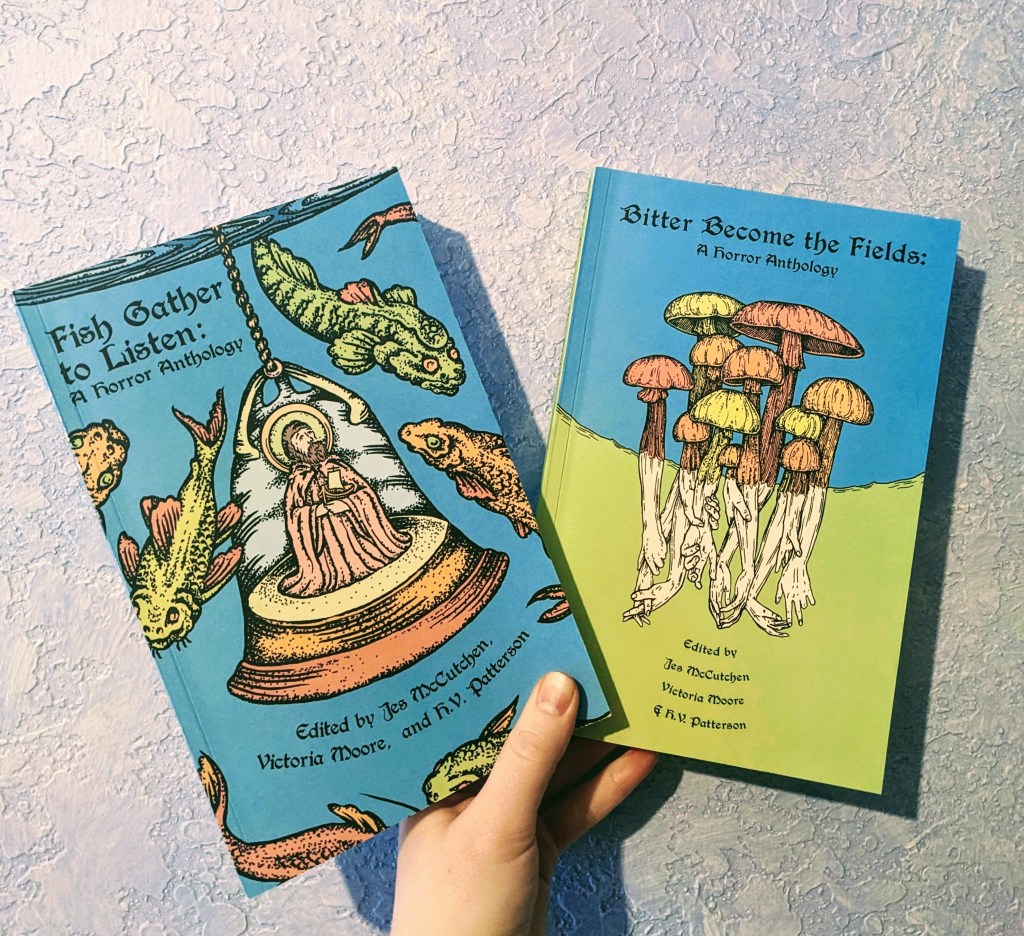
I’m really proud of my religious/folk horror story “Hare Moon”. It was first published in Darkness Beckons edited by Mark Morris from Flame Tree Press and selected for Best Horror of the Year 16 edited by Ellen Datlow. I am also very proud of the anthologies Jes McCutchen, Victoria Moore, and I published with Horns and Rattles Press: Fish Gather to Listen (2023), featuring water-based horror, and Bitter Become the Fields (2024), featuring plant and fungal horror.
What are your upcoming works and plans for the future?
I just sold a Bluebeard-inspired horror flash to Orange and Bee called “Osedax” that’ll be out later this year. I also sold one of my favorite poems I’ve written to 34 Orchard (“The Ocean is Haunted and So Am I”), but that’s not out until 2026.
I also have a few stories out in anthologies this year. The first one, “Practical Applications of Fungal Bioremediation”, just came out in BOREAL: An Anthology of Taiga Horror from Strange Wilds Press edited by Katherine Silva. Katherine has done an amazing job editing and promoting this anthology, and I’m really excited to read the other stories!
In 2025-2026, I’d really like to focus more on longer fiction. I have three half-written novels and a few languishing novella projects, and I need to choose one to focus on. I love writing shorter works and poetry, but, realistically, I think it’s easier to get recognition as a writer if you have at least one longer work out in the world. There are also some stories which can only be told in longer form.
 KANDISHA PRESS
Leave a comment