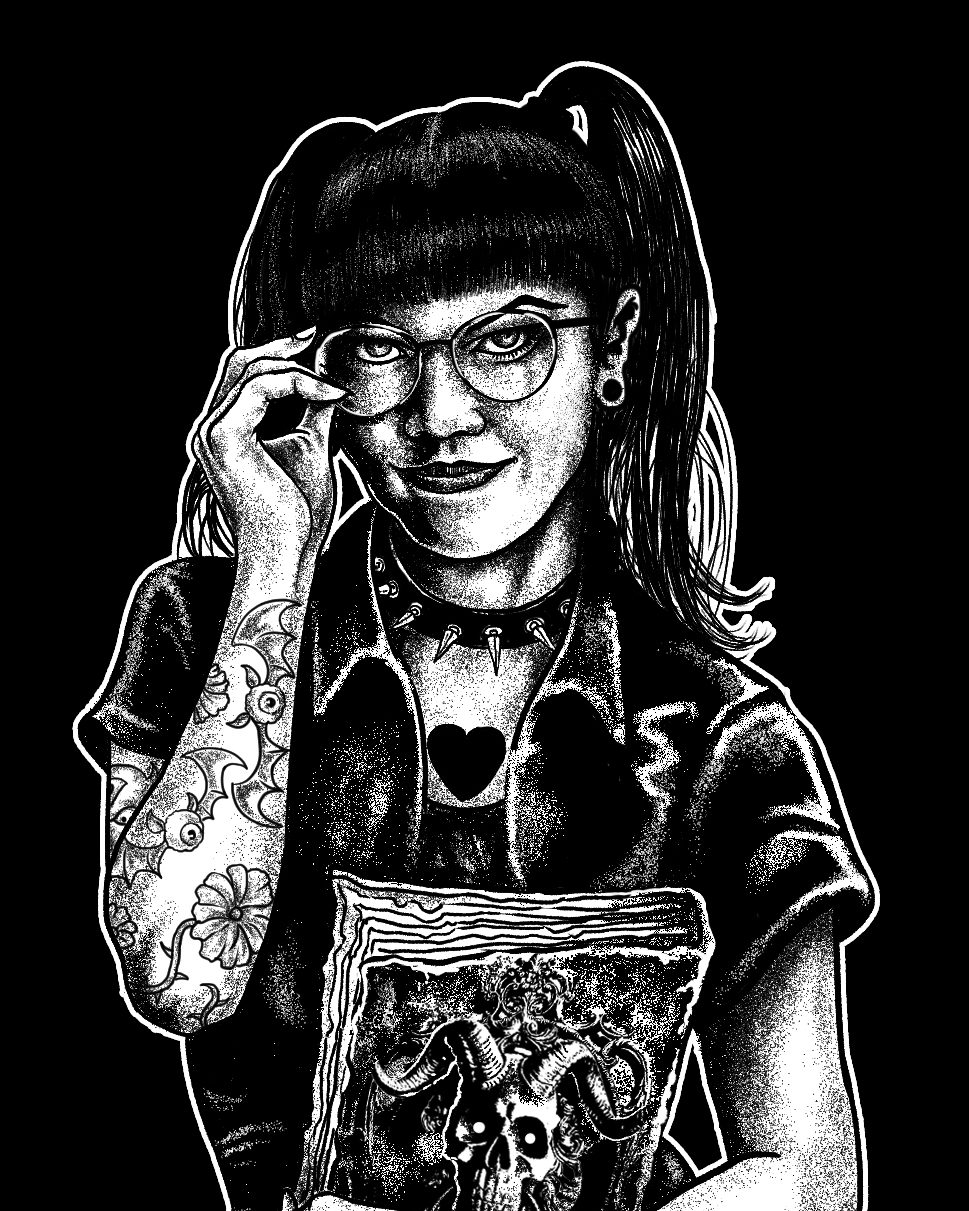

GREETINGS, BOOKWORMS! I’m Aisha Kandisha, Head Librarian at Kandisha Press. Join me in the dusty stacks of the library I will never leave again as I chat with some of my favorite Women in Horror. Today we feature author Alexandra Dos Santos!

Alexandra Dos Santos writes fiction, screenplays, and creative nonfiction. She was born and raised in New York, currently living in Astoria. She teaches freshman writing at a local college, and spends her free time watching horror movies and choreographing dance routines to perform around the city. She loves writing the weird and uncanny, with characters who run towards the darkness, not away from it. They, like herself and her horror community, delight in grotesque obsession.
Her essays and short stories have appeared in Vol. 1 Brooklyn, Electric Lit, Lithub, Maudlin House, and The Latino Book Review. She’s currently working on a religious horror novel that draws connections between Catholicism and cosmic horror.
What do you believe are your strengths in writing? And when you feel you need to improve on a particular writing skill, how do you go about it?
People say I’m good at dark humor, though I never set out to make jokes when I’m writing. Maybe pointing out ridiculous, morbid truths is inherently funny. I will say, I think a strength of mine is telling the truth, no matter how unflattering or brutal. Maybe it’s classic Catholic guilt, but I can’t lie convincingly to save my life. It eats away at me until the point I just have to confess myself like the narrator in Tell Tale Heart. It’s like that in my writing, too; I don’t find a story interesting unless it’s playing in the realm of uncomfortable truths.
When it comes to improvement, I think I need to learn to chill and not go overboard with too many ideas in one project. Horror gives writers a unique opportunity to play with metaphysical ideas, and it’s easy to let myself get carried away. I think most good writing is interested in one specific yet complex topic. A center of orbit. My problem is I add too many suns, and then it gets blindingly bright. So it’s always a matter of locating the most important truth—or at least the truth most suited for the story’s lore. My tried and true way to improve this is to encourage my writing friends to ruthlessly rip my stories apart. I try not to have any ego when it comes to bad writing, and I definitely have my blind spots. Community, I’ve found, has been the best way to improve.
What are your thoughts on the book industry today, or more importantly, about the book community?
I generally buy books based on friend or podcast recommendations. Booktok has introduced me to a few extreme horror books, and I’ve found some gems because Youtube channels like Tale Foundry. I used to work in publicity for a Big 5 publisher, so I got to see all the work that goes into traditionally publishing books. There’s so many experts behind those books—agents, editors, copy editors, cover artists, marketers, publicists…it’s a web of connections. It makes me want to go down that route when I publish my debut novel; I like the idea of leaving writing to the writer, and marketing to the marketers. They’re not necessarily transferrable skills, and I don’t think it’s fair (or productive or honest) to force an odd creature like a writer to be anything other than that. It’s also a rather obvious statement, but if you don’t already have a big platform, it’s incredibly hard to get people to read your self-published book.
I love that I’m a part of a specific genre: horror. The community seems to operate at a base level understanding, because to like horror, you have to have a certain level of openness to the taboo. I love being around fearless people like that, because there’s such little space to discuss these things in our “professional” lives (even though I made it a point to teach my students the works of Junji Ito, Tananarive Due, and Karen Russell).
Do you feel it is getting harder or easier to make it as an independent author these days?
I’m at the beginning of my writing career, so I don’t have much of a point of comparison. But I think it’s harder than it used to be to stand out in a crowd. There’s such a surplus of stories vying for attention—both the publishers’ and the readers’—that it’s a miracle anything gets published or randomly picked up in a bookstore. As a writer, you’re supposed to be present on socials so readers can find you, but I’m a teacher; I don’t want my accounts public for students to see. The same is true of a lot of other writer friends of mine. I mean, just being a woman with a public page is risky enough. I’m not trying to get my pictures stolen and used in a catfishing scheme.
There’s definitely other ways to get your name out there; as I mentioned, podcasts and word of mouth are the most reliable, in my experience. I’ve never seen an author’s social media page and went, “Wow, they have a strong social presence. That makes me really want to read their story!” If I hear an intriguing story premise, I don’t care if the writer is self published, a best seller, or somewhere in between. I believe art exists as its own independent entity, and artists are simply the conduits needed to bring the art into physical existence.
Tell us about your work. What story are you most proud of?
The story I’m most proud of is probably not a story at all, but a personal essay. I wrote it for Lithub about a year after my mom passed away. It’s called “Whatever Walked There, Walked Alone.” The title is a quote from The Haunting of Hill House, which I read for the first time that year. That line in particular stood out to me—with Hill House being a sort of sacred space, a portal where imaginal things manifest and dissolve—becuase it’s a lot like watching a loved one die. The memory of it is not just a feeling, but a place. And it’s a place that can open up beneath you at any moment, dropping you into a world of monstrous contradictions—contradictions towering so high above our heads we can’t even look them in the eye. In grief, everything is confusing, and the things you once took for granted, like time and memory, become abstract ideas that also have the power to physically annihilate you. See? A contradiction.
The personal essay goes into all that. It felt only right to turn a dark time into something meaningful that might help others. My mom would want that; she saw meaning in everything, and trusted the truth would be revealed to her when it was ready to. I’m proud of the ways the piece blends fiction and non-fiction, to the point where there’s hardly a boundary at all.
What are your upcoming works and plans for the future?
I finished the first draft of a novel that deals with a lot of my metaphysical curiosities. I wanted to use Catholicism, a religion I grew up in and admire, to explore ideas of freewill and fate. I love a good demon story, but I find using other religious motifs to be more exciting; I want to do something that’s never been done before. I don’t want to say much more, but I hope to start querying agents in the coming months
 KANDISHA PRESS
Leave a comment