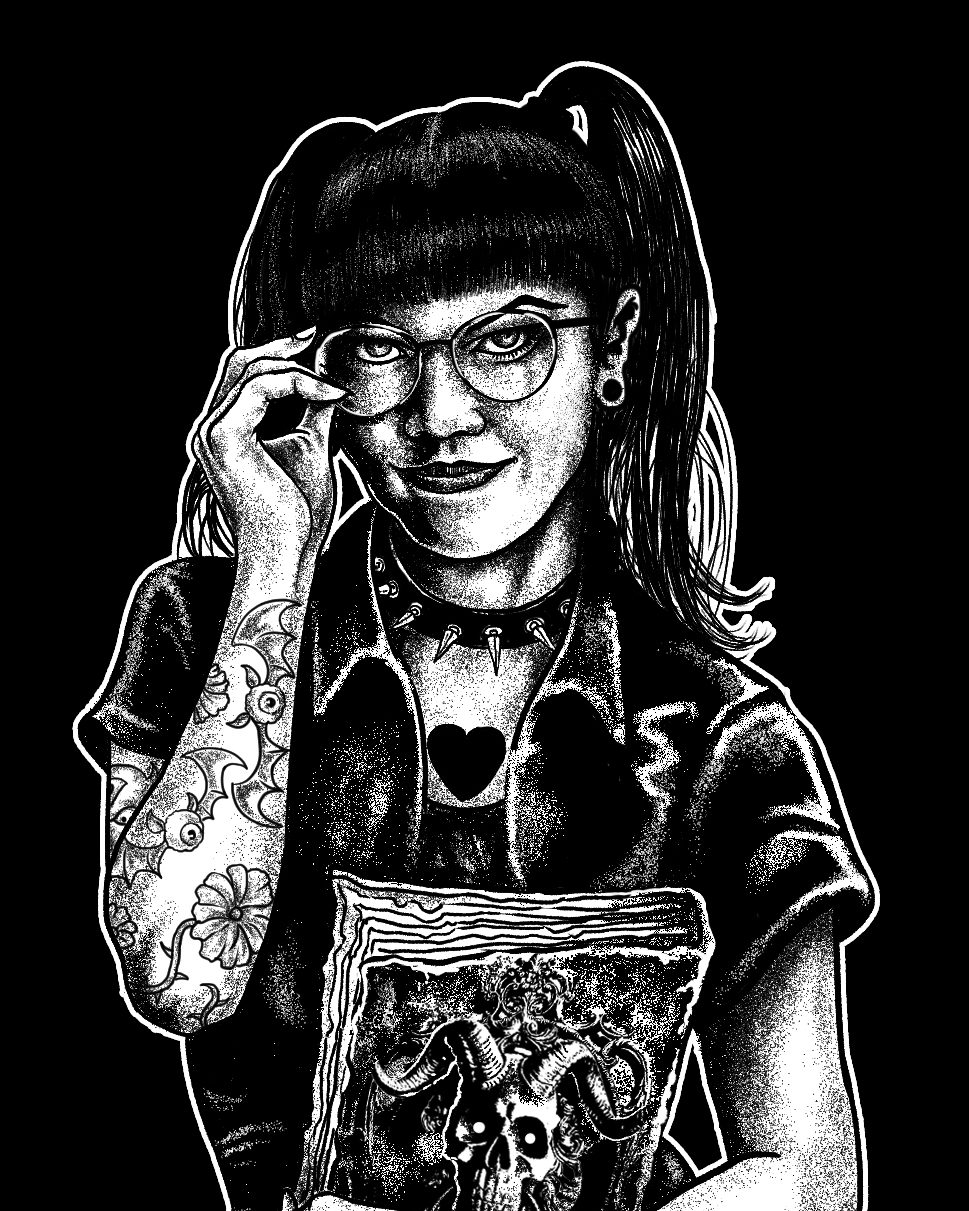

GREETINGS, BOOKWORMS! I’m Aisha Kandisha, Head Librarian at Kandisha Press. Join me in the dusty stacks of the library I will never leave again as I chat with some of my favorite Women in Horror. Today we feature author Sandra Henriques!

An author of Lonely Planet guides, Sandra Henriques debuted in fiction in 2021 after winning the European EACWP Flash Fiction competition with “The Caretaker,” a 100-word horror story.
Her horror short stories have been included in several anthologies, in Portuguese and in English: Sangue Novo (2021), Sangue (2022), Os Melhores Contos da Fábrica do Terror vols. 1 e 2 (2023 and 2024), Dead Letters: Episodes of Epistolary Horror (2023), Onze Contos de Natal (2024), Carne, Vale! Adeus, Carne! (2025) and Inanimate Things vol. 2 (2025). In September 2023, she wrote an entry on Portuguese Horror Female Authors for “Enciclopédia do Terror Português.”
In March 2022, she co-founded Fábrica do Terror, the only website in Portugal dedicated to Portuguese horror, where she acts as editor-in-chief.
She continues to collaborate with Lonely Planet, writing articles and co-authoring guidebooks on Portugal.
What do you believe are your strengths in writing? And when you feel you need to improve on a particular writing skill, how do you go about it?
So, I started my writing career in 2014, writing about travel—first, with a travel blog; then, ghostwriting or writing online articles, sometimes paid, sometimes for “exposure”; eventually, Lonely Planet was looking for a local in Lisbon, fluent in English and Portuguese, who could write articles with a strong sense of place, and later I started writing travel guides for them, too. The switch into horror fiction happened in 2021, when I did a creative writing workshop and won the Portuguese award in a flash fiction competition, represented Portugal in the European final (kind of like Eurovision), and won. The contest accepted any genre; the only rule was the story couldn’t have more than 100 words (excluding the title).
I wouldn’t call it a strength, it’s maybe more of a process if that makes sense. I love to tell a story.
In travel writing, to get that “sense of place”, even if it’s somewhere I’ve been before, I let myself “be” there. So, I’m paying attention to everything: the weather, the smells, the people. But I only start taking notes or outlining a first draft after I’ve left, because that’s when I realize what stuck, what I remember and why.
In fiction, I realized I kind of did the same, except it all happens inside my head. Characters usually come forward first. They pop into my head, with detailed features, like real people. And then the story starts to unspool around them. I don’t take notes, either; if it’s gone in a couple of days, then it wasn’t worth it. And these characters and their stories sometimes stay with me for months before I start writing anything. The first time I noticed I did that was with the award-winning short, “The Caretaker.” I wrote two stories for the competition. The first one was something I thought the jury wanted to read; I absolutely hated it. It didn’t make me feel anything. The second one, “The Caretaker”, I wrote without giving a shit about what the jury would think (there’s zero arrogance in this statement). And I still do it today. Sorry, readers; I love when you love one of my stories, but my commitment is to the characters first. They have a story to tell, and I do my best to tell them.
Regarding improving my writing skills, I’m constantly trying to learn from other authors—reading their biographies to me it’s more revealing than learning “how they do it”—and for the more technical skills, I search for webinars and online workshops. Grammar is my Achilles heel, and I always thought it was too complicated for me to “get”, until I was diagnosed with ADHD two years ago and all pieces of the puzzle fit together. I need courses or books that teach me the logic behind a rule; it won’t work if they tell me “it is what it is.” I also need very concrete examples, so I can understand what the pattern is and identify when something doesn’t or shouldn’t follow the same pattern. The same goes for reading books by other authors, be it their biographies or a book on writing. I tune out if the book is all about “follow my method” or “you should do this” because everyone’s circumstances are different. I prefer authors that share their process and why they do A instead of B, and that share their failures and what they believe didn’t work.
What are your thoughts on the book industry today, or more importantly, about the book community?
It’s still very white and very cisgender male, isn’t it? Anyone else who doesn’t fit that category is still seen as a rarity. I will champion and support anyone who gets there, especially if they’re “the first.” But then the industry checks off that item on their token list, moves on, and we fall back into invisibility, until the next “phenomenon” comes along. That said, the fight has inspired great horror fiction—and I do think horror is the best genre to salt the wounds and leave a mark that might only be understood decades from now, but it exists. As for the book community, I found that the horror authors, book influencers, and readers are the kindest and most supportive group one can hope for. It’s where I truly feel at home as a writer.
Do you feel it is getting harder or easier to make it as an independent author these days?
It depends on what you consider “making it.” To me, “making it” is having my horror stories published, especially when one of my stories is selected for a foreign anthology because then I can really have that feeling of accomplishment that it made the final cut because it was a good story, not because someone knew me.
Authors have more tools and more options to publish now, without having to wait for an agent and that coveted trad deal. In Portugal, the market I’m most familiar with, breaking into traditional publishing is a hit and miss game, one that no one knows the rules. It’s very common to believe most authors “made it” because they have famous parents, or they work as editors in big publishing companies and therefore know the rules of the trade and have good contacts. Authors who choose independent publishing—be it self-publishing or going with a smaller press—are often labeled (by themselves, by readers, by other authors) as not being “good enough” for a bigger publisher. Unfortunately, they are often preyed on by vanity presses, who feed on their despair of being published. In Portugal, it’s difficult for authors to “prove themselves” after being published by a vanity press.
I don’t know if in the United States is better, but the horror genre market is larger so you can submit to open calls and, if selected, publish 3 or 4 times a year, maybe more. In Portugal, there’s maybe one or two literary competitions exclusively dedicated to speculative fiction, and the other broader ones typically dismiss the horror short stories because it’s horror. Open calls for anthologies is also not very common; we might see one a year, maybe? It’s very hard to have someone read a story for the story, without the prejudice.
Tell us about your work. What story are you most proud of?
I don’t think I will ever be 100% proud of a story, but that’s normal, right? I do like to celebrate the ones that convinced me I could actually write horror: “The Caretaker” (for the award and the challenge of writing a juicy story in 100 words. Fortunately, I’ve had a lot of training for that as a travel writer; word limits are tight) and “Next of Kin” (part of the “Dead Letters: Episodes of Epistolary Horror” anthology, published by Crystal Lake Entertainment) because it marked my debut in a non-Portuguese anthology.
What are your upcoming works and plans for the future?
I’ve been trying to overcome my fear of writing a novel or a novella; anything over than 5,000 words, really. So, stop coming up with excuses to not do the work is my near-future plan. I have a story in “Inanimate Things vol. 2”, an anthology by Burial Books that will be out April 18, 2025. It’s a body horror story—that’s marked my writing in the last year or so—called “All I Have to Send You is this Postcard.” The main character, Susan, buys an old postcard at a vintage shop, and soon she’ll realize there’s more to that card than the cryptic message written in the back. Without spoiling it, I can say the story was inspired by an old postcard I found when browsing old magazines at a vintage shop. It had a short message and an address, but no postage and no names (my brain immediately started spinning right there: was it never sent? Did the person hand it instead?). And the rest, well, you’ll have to read it and let me know what’s your interpretation.
 KANDISHA PRESS
Leave a comment