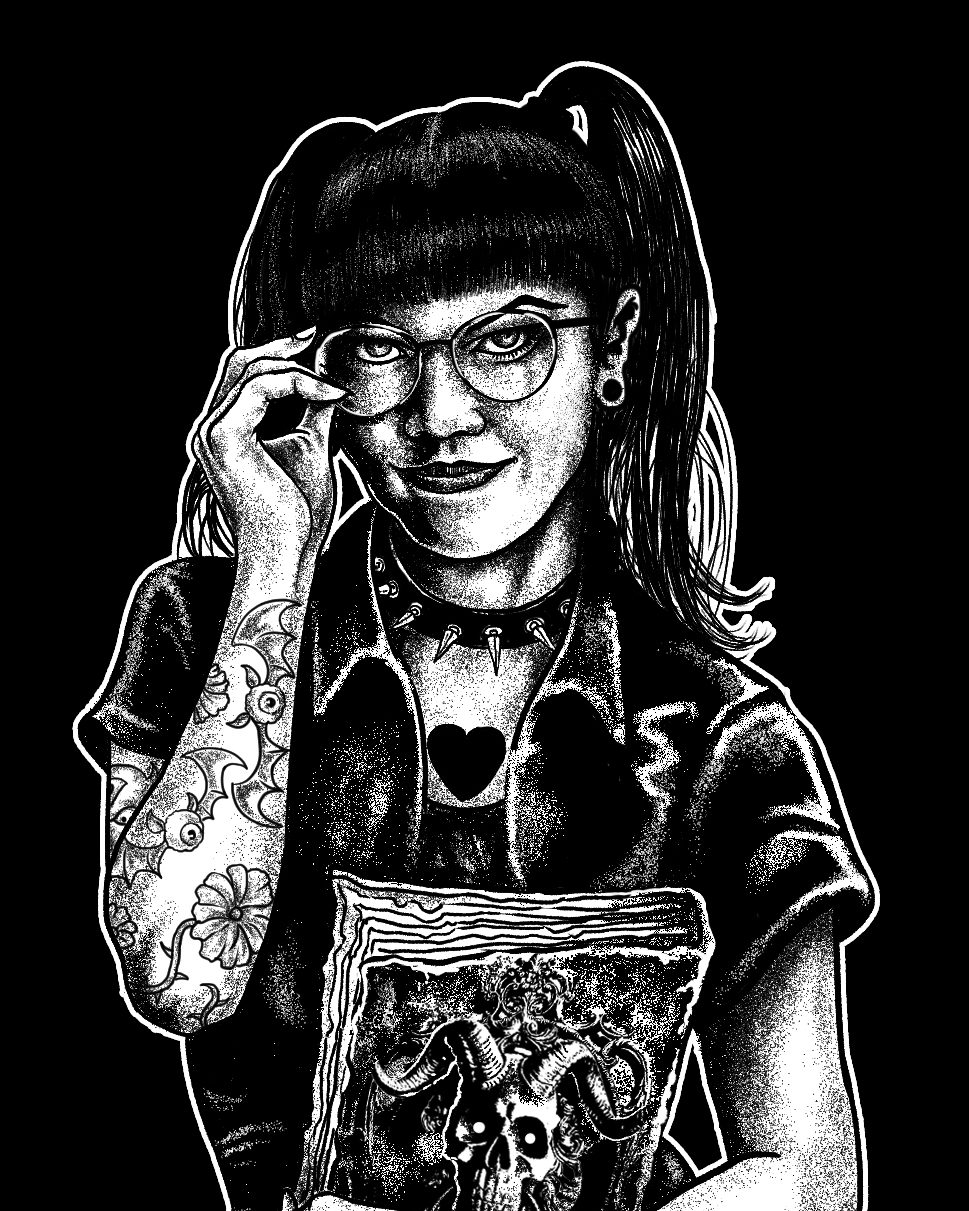

GREETINGS, BOOKWORMS! I’m Aisha Kandisha, Head Librarian at Kandisha Press. Join me in the dusty stacks of the library I will never leave again as I chat with some of my favorite Women in Horror. Today we feature author S.P. Miskowski!
S.P. Miskowski is a recipient of two National Endowment for the Arts Fellowships, one for literature and one for drama. Her books have been recognized with four Shirley Jackson Award nominations and two Bram Stoker Award nominations. Her stories have appeared in many anthologies, including Haunted Nights, Human Monsters, October Dreams II, The Best Horror of the Year Vol. 10, and Darker Companions: 50 Years of Ramsey Campbell, and in magazines including Nightmare Magazine, Vastarien, Cosmic Horror Monthly, Supernatural Tales, Identity Theory, Black Static, and Strange Aeons. Her Bram Stoker Award-nominated grunge noir novel I Wish I Was Like You was named This Is Horror Novel of the Year 2017.
What made you want to become an author? Did you have an “Aha!” moment when you knew you were born to write? Or perhaps a beloved book inspired you?
Becoming an author wasn’t really a conscious choice. I was creating pretty elaborate stories in my head when I was three or four years old and sharing them, telling them to my nephew and my mom and dad. At eight, I was reading stories by Edgar Allan Poe and imitating the creepier aspects in stories of my own. I made little books, drawing the cover art and stapling pages together. To their credit, my hardworking blue-collar parents found all of this entertaining rather than horrifying.
In middle school I had a mentor, an English teacher who “discovered” my so-called talent via essays and class papers. In college I had another mentor who encouraged me to read widely and experiment with fiction. I never worried about the practical applications, never thought about fame and fortune. Some of my jobs have been related to writing and editing, and some definitely have not. But I’m a writer. It’s built into my nervous system. I have to create stories.

Created by Mikio Murakami.
What do you believe are your strengths in writing? And when you feel you need to improve on a particular writing skill, how do you go about it?
People tell me I have a gift for dialogue and characterization. Atmosphere is something I layer into a story while polishing the prose. As a young writer I was challenged by the need to write plausible action. This is something I’ve developed over time, and I still have to outline as I go. I’ll outline the next section or several chapters, adjusting along the way. I need the outlines, but I don’t feel I have to adhere to them if something better occurs to me.
If I need to sharpen one skill or another, I read books by someone who’s really good at it. If you want to understand suspense, read Megan Abbott. If you want to know how to hook readers with the first paragraph, Stephen King is your guy. Want to know how to weave complicated themes into a full-bodied narrative spanning decades? I recommend Janet Fitch’s White Oleander, Celeste Ng’s Little Fires Everywhere, and Kate Elizabeth Russell’s My Dark Vanessa. But really, read everything. Vladimir Nabokov, Ryu Murakami, Donald Barthelme, Barbara Neely, Raymond Chandler, Patricia Highsmith. If you want to write weird fiction or horror, read Laird Barron’s story collections. Read Paula D. Ashe. She’s brilliant. Read Ira Levin, Victor LaValle, and Richard Matheson…
What are your thoughts on the book industry today, or more importantly, about the book community? Do you feel it is getting harder or easier to make it as an independent author these days?
It’s fairly easy to get a book out into the world. There are small presses and there’s always the self-publishing option. This is easier and cheaper than ever to accomplish. And, as always, it’s trickier getting work into the hands of an editor (or publisher or agent) with whom it resonates. Someone who will champion your work and bring it to the attention of reviewers and readers. Someone with an established distribution network.
Figuring out what to do next, that’s the tough part. I’ve seen literally dozens of smart, talented writers get a novel and maybe a collection published, and they do the job, they do the publicity and networking and everything you’re supposed to do. They go to conventions, they set up websites, they meet readers and colleagues, and there’s this momentum that feels like it will carry them to a bigger publishing contract, more recognition, and awards. If those things don’t happen—and they don’t, in most cases, or they take a LOT longer than expected—the writers become discouraged. They doubt themselves and consider giving up. In the worst cases, they become cynical about the whole process and cynicism infects their writing.
I think all of this, the rush and the letdown, is symptomatic of a culture that celebrates new things, and quickly loses interest when the NEXT new thing comes along. All I can say is, you have to love what you’re doing. If you don’t love the act of writing—inventing and typing (or scribbling), sorting out what works and what doesn’t, killing off your darlings, and revising, revising, revising—then you probably shouldn’t do it. Try other forms of expression, until you find out what floats your boat.
Writers like Stephen Graham Jones and Silvia Moreno-Garcia might have appeared on mainstream radar fairly recently. But these writers were working and getting published in small press for a long time. They’ve done the hard work, honing their craft at every step, and eventually they came to the attention of publishers who could support their talent with marketing and distribution. Now everybody knows who they are. They’re celebrated and nominated for awards with almost every book. Because they love writing, they’re good at it, and they stayed the course over the years.
You have to love it. The chances that you’ll become an overnight sensation are slim, no matter how initially entertaining you are. You have to love what you’re doing.
Tell us about your work. What story are you most proud of?
“We’re Never Inviting Amber Again” was selected by Ellen Datlow and Lisa Morton for the anthology Haunted Nights. Both editors were impressed by that story, which is a great feeling. To be recognized by two people I respect enormously, it was a nice moment. I love the anthology, and I’m proud to be included.
“Somnambule” and “Alligator Point” relied upon my childhood memories of adults keeping secrets. I think I was able to bring a world to life in each of those stories, without destroying the mystery at their heart. Readers who like horror to be explicit and clearly defined might not enjoy these stories. But they’ve earned accolades from readers and reviewers who love ambiguity and who like to interpret for themselves rather than being explicitly informed, at every step.
What are your upcoming works and plans for the future?
There has been some interest in filming my second novel, a grunge noir ghost story called I Wish I Was Like You. But you never know how these things will go. I’m revising a new book with notes from an editor I like a lot. If it all comes together, it explores the dynamic between a dangerous stalker and a young investigative reporter. After that, I have in mind another novel set in the fictional, weird town of Skillute, Washington (which was introduced in my debut novel, Knock Knock). I have a small press chapbook coming out in the next year. My series The Skillute Cycle is seeking a new publisher after several years at Omnium Gatherum Media and a wildly successful (and gorgeous) limited edition from Thunderstorm Books. I’m writing stories for a couple of invitation-only anthologies. I’m writing an introduction to a friend’s novel. And there will be an audio recording of my contribution to a Matthew M. Bartlett tribute anthology. Then I’m going to take a nap, get up, and write some more.


It might very well kill us, but we could try! LOL
LikeLike